Facts plus solving workflow
Mechanics: A Practical Puzzle-Reading Method
The announced design is built around systems that keep changing context. Use the workflow here to turn a new board into a clean observation record, then wait for direct evidence before calling a rule universal.
§Interwoven challenges#
The official description presents more than one thousand hand-crafted puzzles and says each puzzle builds on the last by introducing new mechanics.
The useful takeaway for a guide is progression of ideas. A future puzzle entry should explain the rule being tested, the smallest hint that makes it legible, and the exact solution only after verification.
§Read the board before you move#
This is an editorial solving method built around the visual separation shown in the official screenshots. It is guidance for observation, not a claim about an undisclosed rule.
| Layer | Record first | Common mistake it prevents |
|---|---|---|
| Board geometry | Which tiles, edges, paths, and blockers are actually playable | Treating decorative scenery as part of the puzzle |
| Visible state | What is lit, occupied, open, or changed before the test | Remembering the result instead of the starting state |
| Actor context | The hero, world, and objective visible on this screen | Applying a rule from another character or area |
| Smallest test | One reversible interaction or one hypothesis | Changing several variables and losing the cause |
§Run one-variable tests#
When a board is unclear, take a baseline note, change one thing, and compare the result with that baseline. Name the hypothesis in plain language, such as "the light path changes when this object moves", then mark it as observed, disproved, or still open.
If the room offers a reset or undo, record the exact control and whether it restores the same state. If you have not personally confirmed that control, describe the observation as a question instead of promising a reset to another player.
- Take a screenshot or short written snapshot before the test.
- Change one actor, object, or position only.
- Write the visible consequence, including a null result.
- Repeat once if the result could be timing or camera noise.
- Keep the exact solution out of the note until the puzzle identity and sequence are reproducible.
§Use the revisit-friendly structure#
The official description supports coming back to challenges. Turn that freedom into a deliberate notebook loop.
Park
Editorial methodWrite the exact blocker in one sentence, for example "I can reach the far tile but do not know what changes the light state."
Return
Official structure plus methodRevisit after learning a rule elsewhere, then compare the same board state instead of starting from memory.
Prove
Publication standardOnly promote the result to a guide entry when another editor can identify the same context and repeat it.
§Record a world collision without guessing#
| Stage | What a future guide should prove | Current status |
|---|---|---|
| Before | The separate world rule, hero context, and puzzle state | Official concept; details open |
| Intersection | The in-game event or location where worlds or heroes meet | Officially announced; no public route record |
| After | The changed interaction and a reproducible example | Held for playable verification |
§What the design supercollider means in play#
The September 1 developer article gives a more concrete shape to the collision promise: separate mechanical philosophies are designed to combine later.
The official article says the four realms begin with distinct rules, abilities, characters, and secrets. As the player uncovers more in the Overworld, abilities learned in one realm can become available in another, and characters from different locations can meet.
For a player, the practical implication is to keep a note of an ability when it first appears and revisit earlier blockers after a world changes. That is a planning heuristic grounded in the announced design; it is not a claim that every early puzzle has a later cross-world solution.
- When a new ability appears, record its input, visible effect, and the first place you saw it.
- Keep a short list of blocked boards instead of forcing a route order the official material has not stated.
- When a character from another location appears, separate the story event from the exact mechanic it changes.
§Four foundational rule families to recognize#
The official FAQ describes four foundational games behind the project's puzzle lineage. Use this as a recognition aid, not as a claim that the Demo copies each rule one for one.
This comparison is valuable because it gives a player four concrete questions to ask when a Demo board feels opaque: am I building a path, trading places with a reflection, tracing a beam grid, or accounting for a hero's movement and pushing context? The answer still has to come from the board in front of you.
| Foundation reference | High-level rule described officially | Useful observation prompt | Boundary |
|---|---|---|---|
| Skipping Stones to Lonely Homes | Throw stones to create paths | Watch what becomes reachable after a path is created | Do not assume every path interaction in the Demo uses this rule |
| Mirror Isles | Swap with reflections | Check whether the reflected position changes the available route | A video title naming Mirror Isles does not verify a Demo room |
| Promesst | Use beams through cave-like grid spaces | Separate the beam's visible route from the surrounding environment | Do not publish an exact beam sequence without a playable check |
| Heroes of Sokoban | Different hero professions move or push toward exits | Record which hero and which movement or push context is actually present | Role labels do not establish a specific ability |
§Read the decorative shell and the interactive structure#
The developer's September 9 making-of article explains why screenshots can look busy while the puzzle grid remains intentional.
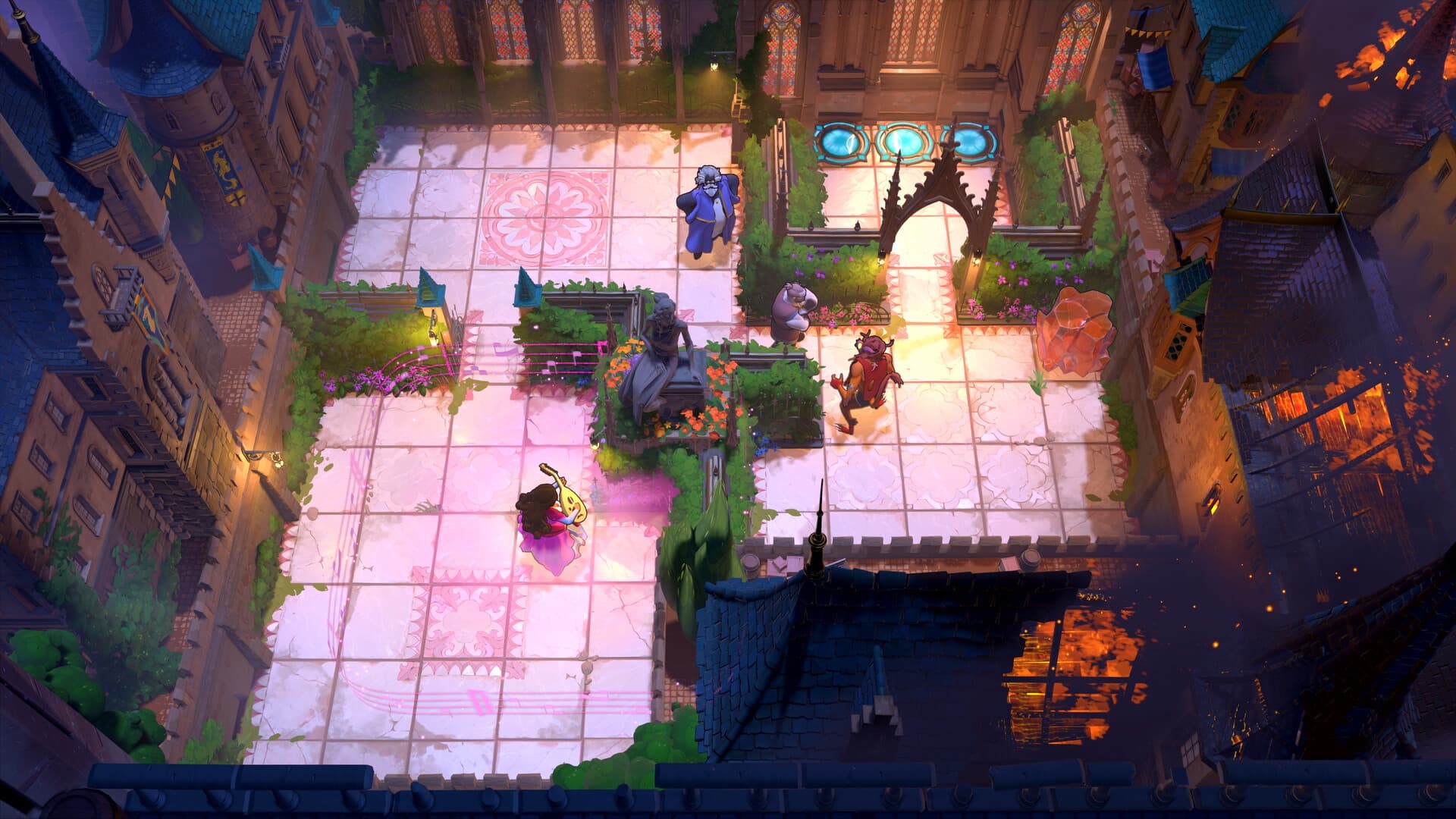
The art lead describes a decorative shell placed over the cubes that form the actual interactive structure of puzzle spaces. The team also uses subtle cues such as plants, architecture, and rock types to show when one world's elements begin appearing in another.
The article gives water as a concrete example: some worlds do not contain pooled water, so water becomes a highlighted gameplay idea when a world where it exists merges with one where it was previously absent. Treat this as an official design explanation, not a universal instruction to search every board for water.
- First identify the cube or grid structure that the puzzle actually acts on.
- Then inspect the surrounding shell for a plant, rock, architecture, or water cue that may signal a world overlap.
- If a visual detail is hard to read, change one presentation setting or camera position and compare the same state before changing your puzzle hypothesis.
§World-specific rules#
Steam describes four distinct worlds, each with its own mechanics, characters, and stories. The current public pages do not provide a complete world-by-world rule index, so the atlas keeps those names and routes open for evidence.
§Revisit and return#
The store description says players can explore at their own pace, come and go, and return to challenges. That supports a guide organized around puzzle states and discoveries rather than a single forced route.
§Hero abilities#
The official overview says playable characters have complementary abilities. The public material names roles, while detailed abilities and unlock conditions remain open for hands-on review.
Track the rule
Editorial methodRecord what a mechanic changes before recording how to exploit it.
Track the context
Editorial methodNote which world, hero, and puzzle state makes the rule relevant.
Track the proof
Editorial methodKeep a solution out of the public guide until the sequence is reproducible.
§FAQ#
Are all mechanics documented here?
No. This pre-release page records the official high-level structure. Detailed mechanics will be added after direct verification.
Does revisit-friendly exploration mean there is no route order?
The official description emphasizes exploring at your own pace. A reliable route order still needs to be established in the released game.
How do I avoid a false mechanic claim?
Keep the board context, starting state, single test, and visible consequence together. A result that appears in one room is a local observation until another context reproduces it.
§Related pages#
Home
Order of the Sinking Star Guide
A source-tracked pre-release guide to the official facts, demo notes, puzzle systems, heroes, worlds, and launch platforms for Order of the Sinking Star.
Database
Worlds: Four Realms to Track
A spoiler-aware four-world workbook for recording entrances, local rules, return points, and later collisions without filling open fields with invented routes.
Character
Characters: Heroes in the Official Snapshot
A spoiler-light character workbook for the queen, thief, warrior, wizard, and talking boat, with evidence fields for abilities, story layers, and puzzle context.
Hub
Puzzle Help with Spoiler Control
A spoiler-aware help desk for Order of the Sinking Star, with request templates, a nudge-to-solution ladder, and a transparent queue for puzzle records awaiting verification.